
Resource Cards

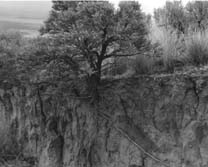
The root system of sagebrush has a deep tap root and shallow branching roots.

Driving through arid lands of eastern Washington and Oregon, you look out to what seems to be a sea of gray-green shrubs. The most common shrub scattered across the landscape is big sagebrush. It grows in a community with bunchgrasses in silty and sandy soils throughout the Columbia Basin and on the slopes of adjoining hills. But other kinds of sagebrush grow in the Mid-Columbia too. For instance, you can find scattered patches of three-tip sage along the crests of the Rattlesnake Hills and stiff sage on rocky outcrops of Gable Mountain, the Saddle Mountains, and Umtanum Ridge. Sagebrush is one of many plants native to our shrub-steppe ecoregion.
What is sagebrush?
Sagebrush is a woody shrub with silvery leaves that stay green all year. Each leaf of big sagebrush has three lobes. Usually, the plant grows to about 4 feet, but scientists have found shrubs taller than 10 feet in areas with deep soil and plenty of moisture. In late summer or early fall, small golden yellow flowers bloom on sagebrush plants, but you have to look closely to see them. You can identify sagebrush easily by its sharp odor, especially after rain. Early pioneers traveling along the Oregon Trail described the scent as a mixture of turpentine and camphor.
How does sagebrush grow?
Only certain plants can survive in lands like ours where little rain falls, heavy winds blow, summer is hot, and winter is cold. Sagebrush and other plants have developed ways to adapt to these harsh environmental conditions. For example, the narrow leaves of sagebrush are covered with tiny hairs that give them a silky sheen. This helps protect the plant from drying in heat and wind. Also, the root system of sagebrush has evolved so the plant can water itself. At night, the tap root of sagebrush pulls moisture from deep in the soil up to shallow branching roots that grow near the surface. During the day, the shallow roots use this water to keep the shrub alive.
Although the gnarled branches of sagebrush may seem tough, as with other elements of the natural community, the plant really is fragile. Sagebrush does not come back easily after human disturbance such as urban or agricultural development, or even after natural occurrences such as wildfire. It takes years, maybe lifetimes, for sagebrush to fully grow back. Sagebrush still hasn't returned to some areas of the Columbia Basin burned by a large fire 40 years ago.
What animals are associated with sagebrush?
Sagebrush provides habitat for wild birds and other species. Sage sparrows, sage thrashers, and loggerhead shrikes all build their nests in the plant's branches. Other birds, including larks, burrowing owls, and long-billed curlews nest on the ground in stands of sagebrush. And the shrub is life itself to sage grouse, which nest on the ground around sagebrush and eats its leaves. Creatures such as the pygmy rabbit and sagebrush vole also depend on sagebrush habitat for cover. There is statewide concern for preserving existing sagebrush habitats to maintain diminished populations of these animals. Efforts are being made to protect stands of sagebrush and restore it to damaged habitats. Doing so will help ensure future breeding populations of these birds and other native wildlife species.

 "Science is constructed of facts as a house is of stones. But a collection of facts is no more a science than a heap of stones is a house." Henri Poincare
Keep in mind this fact sheet is intended to be used only as background information to support your effort to encourage inquiry-based science, which parallels the way scientists uncover knowledge and solve problems.

1. Take a hike.
Where to go: Many natural areas exist in the Mid-Columbia Basin where you still can walk among sagebrush and other native plants. The crest of the Horse Heaven Hills, Red Mountain, Badger Mountain, and Wahluke Slope are just a few places in the Tri-Cities vicinity.
What to take: Be sure to take binoculars, a field notebook, sketchbook, or camera. Hike in morning or evening when you'll likely see more wildlife.
What to look for: Common animals you might see while exploring sagebrush country include mule deer, elk, pheasants, pocket mice, and several species of birds. Depending on the time of year and where you go, you'll see, hear, or smell different things. In spring and summer you'll likely encounter darkling beetles on Badger Mountain. In early summer dust or after a fresh snowfall, look for the tracks of jackrabbits or hooved animals such as elk or mule deer. Maybe you'll hear the shrill cry of the curlew (culee culee) in mid March along Horn Rapids Road, or come eye to eye with a coyote on the Wahluke slope.
2. Grow your own.
Native plants such as sagebrush, rabbitbrush, and bunchgrass are good for local landscaping. They require little or no additional water and often are less susceptible to insects, disease, and drought. Also, using these plants helps replace those lost to human development and wildfire. Local botanists say grasses such as bottlebrush squirreltail, Sandberg's bluegrass, and bluebunch wheatgrass germinate and grow well if you're willing to collect your own seed. Some nurseries in the Mid-Columbia now sell sagebrush seedlings and other native plants. Ask about their availability.

- A Practical Guide for the Amateur Naturalist, 1988. Gerald Durrell, Alfred A. Knopf, New York, New York.
- Common Wildflowers of the Shrub-Steppe Region, 1997. Arid Lands Field Institute, University Center for Professional Development, Washington State University Tri-Cities, Richland, Washington (Available at the Consolidated Information Center Libraries, WSU Tri-Cities).
- Sagebrush Country, 1974. Ronald Taylor and Rolf Valum, Touchstone Press, Beaverton, Oregon.
- Shrub-Steppe Seasons: A Natural History of the Mid-Columbia Basin, 1995. Lee E. Rogers, Pacific Northwest Laboratory, Richland, Washington (available at the Consolidated Information Center Libraries at WSU Tri-Cities).
- Vascular Plants of the Hanford Site, 1992. M. R. Sackschewsky, D.S. Landeen, J.L. Downs, W.H. Rickard, and G.I. Baird, Westinghous Hanford Company, WHC-EP-0554, Richland, Washington (available at the Consolidated Information Center Libraries, WSU Tri-Cities).

- Garden Guides: Big Sagebrush - http://rbcm1.rbcm.gov.bc.ca/end_species/species/sgros.html
- Washington Department of Fish and Wildlife Shrubstette Ecology - http://wdfw.wa.gov/conservation/research/projects/shrubsteppe/

Initial development and printing was funded by the Partnership for Arid Land Stewardship (PALS). Project Manager: Karen Wieda. Written by: Lynn Fulton, Columbia School District. Series Editor: Georganne O'Connor; Design: WinSome Design.
